
Search has changed.
A few years ago, most businesses had one simple digital marketing goal: rank higher on Google.
The strategy was familiar. Businesses researched keywords, optimized website pages, published blogs, built backlinks, improved technical SEO, and worked toward getting more organic traffic.
Those activities are still important.
But the search experience itself is evolving.
People are asking longer and more conversational questions. Search engines are providing more direct answers. AI-powered search experiences can summarize information, compare options, answer follow-up questions, and help users make decisions without requiring them to visit several websites.
As a result, businesses are now hearing three important terms:
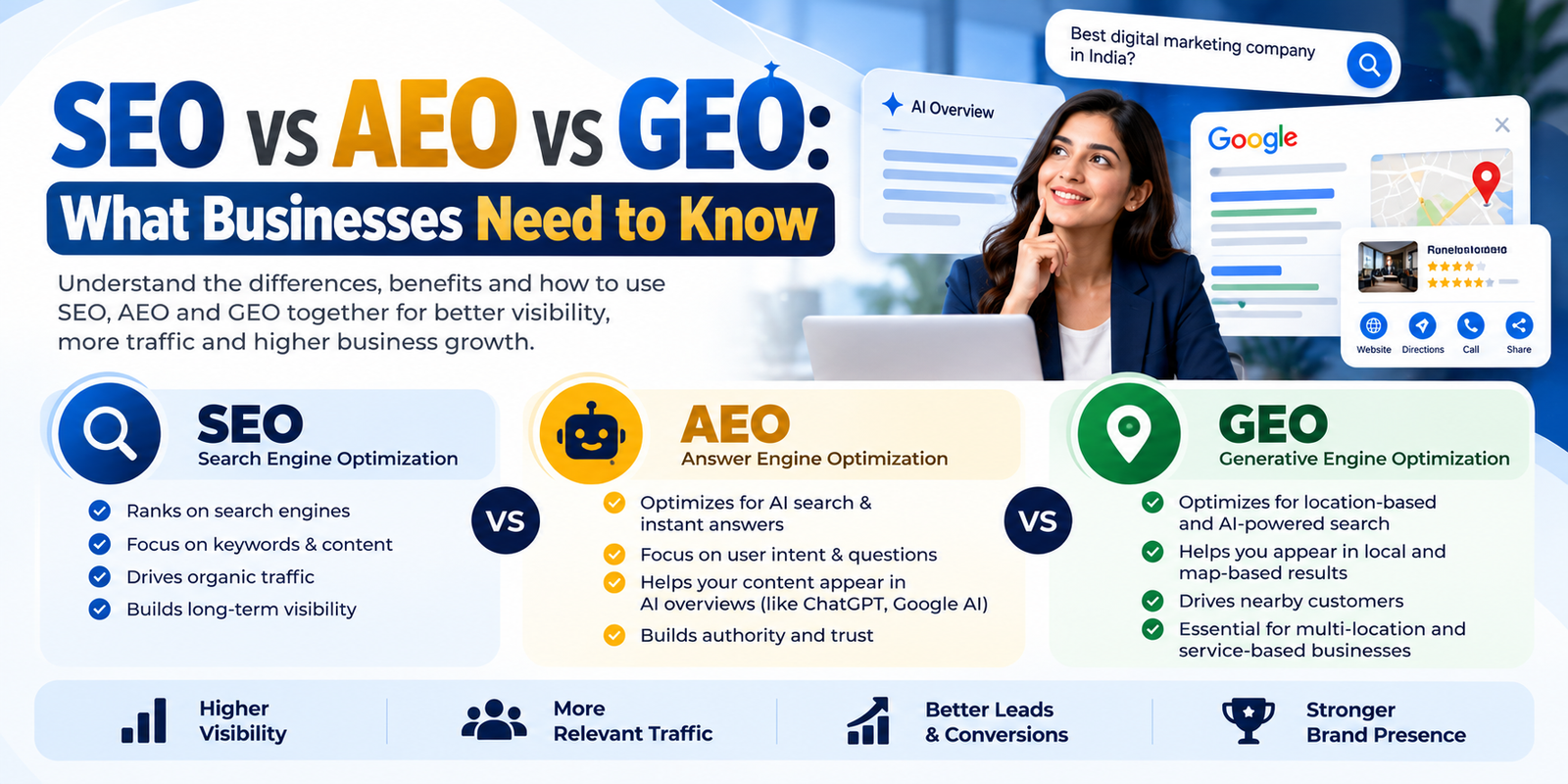
SEO, AEO, and GEO.
While these terms are closely related, they are not exactly the same.
Understanding the difference can help businesses build a more complete search strategy instead of focusing only on traditional keyword rankings.
What Is SEO?
SEO stands for Search Engine Optimization.
SEO is the process of improving a website so that it can achieve better visibility in organic search results.
The objective is to help search engines understand your website and determine when your content is relevant to a user's search.
A traditional SEO strategy can include:
- Keyword research
- On-page optimization
- Technical SEO
- Content optimization
- Internal linking
- Website speed optimization
- Mobile optimization
- Local SEO
- Digital PR and authority building
- Image optimization
- Structured data
- User experience improvements
For example, imagine someone searches:
"best digital marketing agency for small businesses"
A traditional SEO strategy would focus on creating a useful page targeting that intent, optimizing its content and technical elements, building authority, and making sure search engines can discover and understand the page.
SEO is fundamentally about search visibility.
What Is AEO?
AEO stands for Answer Engine Optimization.
Instead of focusing only on ranking a page for a keyword, AEO focuses on making content easier for search systems and answer engines to understand and use when responding to questions.
Think about how people search today.
Instead of typing:
"SEO benefits"
someone may ask:
"What are the benefits of SEO for a small business?"
Or:
"How long does SEO take to produce results?"
Or:
"Is SEO better than Google Ads for a new business?"
These are questions that require answers, not just pages containing keywords.
AEO encourages businesses to create content that provides clear, direct and useful answers to the questions their customers are asking.
AEO content often includes:
- Clear question-based headings
- Direct answers
- FAQs
- Step-by-step explanations
- Lists
- Comparisons
- Definitions
- Tables where useful
- Supporting examples
- Well-structured content
For example:
What is local SEO?
Local SEO is the process of improving a business's online visibility for searches connected to a specific geographic location.
The answer is immediately clear.
The rest of the section can then provide more detailed information, examples and practical recommendations.
That combination makes the content useful for both people and modern search experiences.
What Is GEO?
GEO stands for Generative Engine Optimization.
GEO focuses on improving a brand's visibility and representation in generative AI-powered search experiences.
Traditional search usually presents a collection of webpages.
Generative search can instead synthesize information from multiple sources and provide an answer or summary.
This creates a different type of visibility opportunity.
A user might ask:
"What should a small business look for when choosing an SEO agency?"
An AI-powered search experience may provide a detailed response covering factors such as:
- Experience
- Services
- Reviews
- Industry knowledge
- Case studies
- Pricing
- Reporting
- Technical capabilities
The goal for a business is therefore not simply to rank for the exact question.
It is to become a credible and useful source of information around the subject.
This is where GEO becomes relevant.
SEO vs AEO vs GEO: What's the Difference?
The simplest way to understand the three is:
| Strategy | Main Focus | Primary Goal |
|---|---|---|
| SEO | Search engines & organic results | Improve organic visibility |
| AEO | Questions & direct answers | Become a useful answer source |
| GEO | Generative AI search | Improve visibility in AI-generated responses |
But there is an important point to understand.
These aren't three completely separate marketing activities.
They overlap significantly.
A well-optimized, authoritative, useful page can potentially support SEO, AEO and GEO at the same time.
Why Businesses Shouldn't Choose Only One
A common mistake is thinking:
"Should I do SEO, AEO or GEO?"
In most cases, the better question is:
"How can I build an SEO strategy that also supports answer-based and generative search?"
Your website still needs strong technical foundations.
Your pages still need to be crawlable and indexable.
Your content still needs to satisfy search intent.
Your brand still needs authority and trust.
And your content should increasingly provide clear answers to real customer questions.
That means the strongest strategy combines the three rather than treating them as competitors.
SEO Builds the Foundation
Think of SEO as the foundation of your search strategy.
Without a technically healthy website and relevant content, other optimization efforts become much harder.
Your SEO foundation should include:
Technical SEO
Make sure search engines can crawl and index your website.
On-Page SEO
Optimize titles, headings, content, URLs, images and other page elements.
Content
Publish genuinely useful information that matches search intent.
Internal Linking
Connect related pages so users and search engines can understand the relationship between topics.
Local SEO
For location-based businesses, optimize your local presence and location-specific content.
Website Experience
Make your website fast, mobile-friendly, accessible and easy to navigate.
SEO provides the structure on which AEO and GEO strategies can build.
AEO Helps You Become the Answer
Once the foundation is strong, businesses should start thinking about questions.
What does your customer ask before contacting you?
What problems are they trying to solve?
What objections do they have?
What comparisons do they make?
For example, a website development company may receive questions like:
- How much does a business website cost?
- How long does website development take?
- Should I choose WordPress or a custom website?
- How important is mobile responsiveness?
- Does website speed affect SEO?
- How can a website generate more leads?
Each question represents a potential content opportunity.
Instead of creating content simply because a keyword has search volume, businesses can create content around the real questions their audience needs answered.
That is the core idea behind AEO.
GEO Adds Another Layer of Visibility
Generative search introduces another consideration.
AI systems need to understand:
Who are you?
What does your company do?
What subjects are you knowledgeable about?
What information can your website reliably provide?
This is one reason consistent, authoritative content matters.
Suppose an agency says it provides SEO services.
Its website has one short service page and almost no supporting information.
Now compare that with another agency that has detailed content covering:
- SEO strategy
- Technical SEO
- Local SEO
- Content strategy
- AEO
- AI Search
- SEO reporting
- Keyword research
- Website optimization
- SEO mistakes
- SEO pricing
- Case studies
The second website gives search systems considerably more context about the company's expertise.
This doesn't guarantee AI visibility.
But it creates a much stronger information ecosystem.
How Content Strategy Changes With SEO, AEO and GEO
Traditional content strategy often looked something like this:
Keyword → Blog → Ranking → Traffic
A modern strategy can look more like:
Customer question → Search intent → Useful content → Supporting topics → Internal links → Brand authority → Search visibility
This is a significant shift.
The objective isn't simply to publish more articles.
The objective is to create better information architecture around the problems your customers actually care about.
Example: A Digital Marketing Agency
Let's say a digital marketing agency wants to attract businesses looking for SEO services.
A traditional SEO strategy might target:
"SEO agency"
The agency creates a service page optimized for that keyword.
That's useful.
But a broader strategy could include:
Main Service Page
SEO Services
Supporting Content
- What is SEO?
- How does SEO work?
- How long does SEO take?
- SEO vs Google Ads
- Local SEO for small businesses
- Common SEO mistakes
- How to measure SEO results
- How AI Search is changing SEO
- SEO vs AEO vs GEO
- How to choose an SEO agency
Now the website covers the main service as well as the questions surrounding it.
The pages can be connected through relevant internal links.
This creates a stronger topical ecosystem.
What Makes Content More Useful for AEO and GEO?
There is no magic formula that guarantees inclusion in an AI-generated answer.
However, businesses can improve the quality and usefulness of their content by following strong content principles.
1. Answer the Main Question Early
Don't make readers go through 1,000 words before finding the basic answer.
Give them the core information first.
Then provide depth.
2. Use Clear Headings
Organize the article around logical questions and subtopics.
Good structure helps both users and search systems understand the page.
3. Provide Context
A short answer is useful, but context makes it more valuable.
Explain:
- Why something matters
- When it applies
- When it doesn't
- What the alternatives are
- What mistakes people should avoid
4. Add Original Insights
Generic information is easy to reproduce.
Your experience is harder to replicate.
Use:
- Case studies
- Examples
- Original observations
- Expert commentary
- Processes
- Industry-specific insights
5. Keep Information Accurate
AI-powered search makes accuracy particularly important.
Review outdated information and update pages when necessary.
6. Write for Humans First
Don't make content awkward just because you're trying to optimize for AI.
If a real person wouldn't enjoy reading it, the content probably needs improvement.
Does AEO Replace SEO?
No.
AEO should be considered an extension of a broader search strategy rather than a complete replacement for SEO.
A website still needs:
- Technical SEO
- Quality content
- Strong information architecture
- Internal linking
- Mobile usability
- Good page experience
- Search visibility
AEO adds another layer by focusing more directly on questions and answers.
Does GEO Replace SEO?
Again, no.
Generative search doesn't eliminate the importance of traditional search optimization.
Google continues to emphasize fundamental SEO practices and people-first content, including useful, reliable and original information. Its documentation also provides guidance for websites appearing in AI-powered search experiences.
That means businesses should not abandon SEO because AI Search is growing.
Instead, they should evolve their SEO strategy.
The Role of AI in SEO Content
AI tools have also changed how marketers create content.
They can help with:
- Topic research
- Brainstorming
- Content outlines
- Content organization
- Editing
- Summarization
- Identifying related questions
- Content analysis
But AI-generated content should not automatically be considered high-quality content.
The real value comes from combining technology with human knowledge.
A strong workflow is:
Research → AI assistance → Human expertise → Fact checking → Editing → Optimization → Publishing → Performance analysis
The human element remains important because businesses need content that reflects real experience rather than generic information.
How Businesses Can Build an SEO + AEO + GEO Strategy
Here is a practical approach businesses can start using.
Step 1: Identify Your Core Services
Start with the products or services that generate revenue.
Step 2: Understand Your Audience
Identify their problems, questions, concerns and buying decisions.
Step 3: Research Search Intent
Don't look only at keywords.
Understand why someone is searching.
Step 4: Build Topic Clusters
Create a main service page and supporting content around related questions.
Step 5: Improve Existing Content
Before creating hundreds of new articles, update pages that already have potential.
Step 6: Add Direct Answers
Where appropriate, answer important questions clearly and concisely.
Step 7: Strengthen Internal Linking
Connect related pages naturally.
Step 8: Demonstrate Expertise
Add original examples, experience, case studies and useful insights.
Step 9: Improve Technical SEO
Make sure the website is crawlable, indexable, fast and mobile-friendly.
Step 10: Measure Business Results
Don't measure success only through rankings.
Also monitor:
- Organic traffic
- Search impressions
- Clicks
- Leads
- Conversions
- Branded searches
- Engagement
- Relevant search visibility
Ultimately, the purpose of SEO is not simply to generate traffic.
It is to generate valuable business outcomes.
SEO, AEO and GEO for Local Businesses
Local businesses have another important opportunity.
Suppose someone searches:
"Best dental clinic near me"
or:
"SEO agency in Prayagraj"
or:
"Best website development company in Delhi"
The search has a strong geographic component.
A local strategy should therefore include:
- Location-specific service pages
- Google Business Profile optimization
- Consistent business information
- Local content
- Customer reviews
- Location-based FAQs
- Relevant local references
- Strong service-area information
For local businesses, SEO, AEO and GEO should work alongside local search optimization.
Why Your Website Matters More Than Ever
One of the biggest mistakes businesses can make is treating their website as a digital brochure.
Your website should be the central source of information about your business.
It should clearly communicate:
- Who you are
- What you offer
- Who you help
- Where you operate
- Why customers should trust you
- What makes your approach different
- How customers can contact you
A strong website also gives you a place to publish the detailed information that supports your SEO, AEO and GEO strategy.
How Evisibility Solutions Approaches Modern Search
At Evisibility Solutions, we understand that search marketing is no longer limited to traditional keyword rankings.
Businesses need a broader digital strategy that brings together SEO, paid advertising, website development, content creation and modern search optimization.
Our approach focuses on understanding the business first and then building a strategy around its audience, services and goals.
For SEO, this can include technical optimization, on-page improvements, content strategy, local search optimization and ongoing performance analysis.
For paid advertising, the focus is on reaching relevant audiences and turning advertising investment into meaningful leads and business opportunities.
And when it comes to websites, the goal is not simply to create something visually attractive. A business website should be fast, mobile-friendly, easy to navigate, search-friendly and designed to support conversions.
As search continues to evolve, we also pay attention to AEO, AI Search and GEO-oriented content strategies so businesses can prepare for the changing ways people discover information online.
The Future of Search Is Not SEO vs AEO vs GEO
The future isn't about choosing one.
It's about understanding how they fit together.
Think of it this way:
SEO = Be discoverable.
AEO = Be the answer.
GEO = Be represented in generative search experiences.
Together, they create a broader approach to digital visibility.
Businesses that focus only on rankings may miss new search opportunities.
Businesses that focus only on AI search may neglect the technical and content foundations that make their websites useful in the first place.
The strongest approach is to build a website that is:
Technically strong.
Useful to people.
Easy to understand.
Authoritative in its subject area.
Relevant to search intent.
Consistent in its information.
And ultimately, valuable enough that users want to trust and engage with the business.
Final Thoughts
SEO is not disappearing.
AEO is not a replacement for SEO.
GEO is not a magic shortcut to appearing in AI answers.
Instead, all three represent different aspects of the same larger change:
Search is becoming more intelligent and more conversational.
Businesses that succeed in this environment will need to think beyond individual keywords and focus on the complete information needs of their audience.
Create useful content.
Answer real questions.
Build genuine expertise.
Keep your website technically healthy.
Strengthen your brand.
Connect related information.
And most importantly, create content that helps people make better decisions.
That is the foundation of a search strategy that can adapt—not just to today's Google results, but to the evolving world of AI-powered search.
Ready to improve your search visibility?
Explore how Evisibility Solutions can support your digital growth.